DTC 1-2: Abs Pump Motor
- Check ABS MOTOR (40-amp) fuse in underhood ABS fuse/relay block. See Figure
or Figure
. Replace fuse if blown, and retest system. If fuse is okay, check ABS UNIT (10-amp) fuse in underhood ABS fuse/relay block. If fuse is okay, go to next step. Replace fuse if blown, and relieve system pressure from ABS modulator unit bleed screw. Start engine. If fuse blows again, check for short to ground in ABS pump motor check circuit. See WIRING DIAGRAMS
.
- Remove and test ABS pump motor relay from underhood ABS fuse/relay block. See RELAY TEST under DIAGNOSIS & TESTING. Replace relay as necessary. If relay tests okay, relieve system pressure. See RELIEVING ACCUMULATOR/LINE PRESSURE under BLEEDING BRAKE SYSTEM. Using a 2 mm. or larger diameter jumper wire, connect MOTOR terminal to BATTERY terminal of ABS pump motor relay connector. See Figure
. If ABS pump motor does not run, go to step 8). If ABS pump motor runs, recheck ABS UNIT (10-amp) fuse. If fuse is okay, go to next step. If fuse is blown, repair short in Green wire between ABS control unit and underhood ABS fuse/relay block. See WIRING DIAGRAMS
.
- Remove jumper wire. Disconnect 3-pin connector from underhood ABS fuse/relay block. Turn ignition on. Using DVOM, measure voltage between ground and ABS pump motor relay connector MOTOR terminal. See Figure
. Reading should be approximately 10 volts. If voltage is not as specified, go to step 11). If voltage is as specified, go to next step.
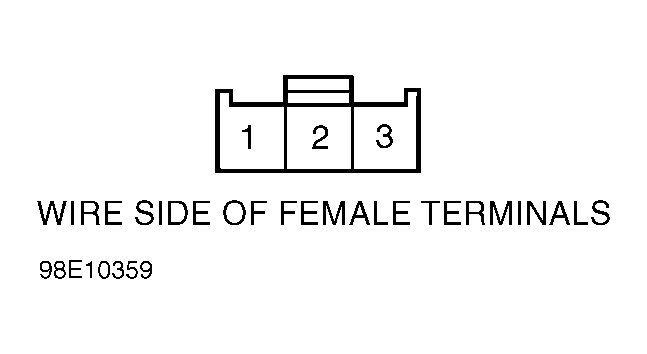
- Using DVOM, measure voltage between ground and underhood ABS fuse/relay block 3-pin connector terminal No. 2 (Yellow/Black wire). See Fig 1
. If battery voltage exists, go to next step. If battery voltage does not exist, repair open in Yellow/Black wire between underhood ABS fuse/relay block and R/C MIRROR (7.5-amp) fuse in underdash fuse/relay block.
- Reconnect 3-pin underhood ABS fuse/relay block connector. Install ABS pump motor relay. If ABS pump motor does not operate, go to next step. If ABS pump motor operates, go to step 13).
- Using DVOM, measure voltage between ground and underhood ABS fuse/relay block 3-pin connector terminal No. 3 (Yellow/Red wire). See Fig 1
. If battery voltage does not exist, replace underhood ABS fuse/relay block. If battery voltage exists, go to next step.
- Measure voltage between ground and ABS control unit 22-pin connector terminal No. 21 (Yellow/Red wire). See Figure
. If battery voltage does not exist, repair open in Yellow/Red wire between ABS control unit and underhood ABS fuse/relay block. See WIRING DIAGRAMS
. If battery voltage exists, reconnect all connectors, and relieve system pressure. See RELIEVING ACCUMULATOR/LINE PRESSURE under BLEEDING BRAKE SYSTEM
. Start engine. If DTC 1-2 resets, replace ABS control unit.
- Using a 2 mm. or larger diameter jumper wire, connect MOTOR terminal to BATTERY terminal of ABS pump motor relay connector. See Figure
. Measure voltage between ground and underhood ABS fuse/relay block 3-pin connector terminal No. 1 (White/Blue wire). See Fig 1
. If battery voltage exists, go to next step. If battery voltage does not exist, replace underhood ABS fuse/relay block.
- Disconnect ABS pump motor 2-pin connector. Measure voltage between ground and ABS pump motor 2-pin connector terminal No. 1 (White/Blue wire). See Fig 2
. If battery voltage exists, go to next step. If battery voltage does not exist, repair open in White/Blue wire between ABS pump motor and underhood ABS fuse/relay block. See WIRING DIAGRAMS
.
- Measure voltage between ABS pump motor connector terminals No. 1 and 2. If battery voltage exists, replace ABS pump motor. If battery voltage does not exist, repair open in ground circuit (Black wire) to ABS pump motor 2-pin connector terminal No. 2. See Fig 2
. See WIRING DIAGRAMS
.
- Disconnect underhood ABS fuse/relay block 4-pin connector. Measure voltage between ground and underhood ABS fuse/relay block 4-pin connector terminal No. 2 (Green wire). See Figure
. Reading should be approximately 10 volts. If voltage is not as specified, go to next step. If voltage is as specified, replace underhood ABS fuse/relay block.
- Measure voltage between ground and ABS control unit 26-pin connector terminal No. 17 (Green wire). See Figure
. Reading should be approximately 10 volts. If voltage is as specified, repair open in Green wire between ABS control unit and underhood ABS fuse/relay block. See WIRING DIAGRAMS
. If voltage is not as specified, check for poor connection at ABS control unit. If connection is okay, replace ABS control unit.
- Remove ABS pump motor relay from underhood ABS fuse/relay block. See Figure
. Disconnect underhood ABS fuse/relay block 3-pin connector. Check for continuity between ground and ABS pump motor relay connector PMR terminal. See Figure
. If continuity does not exist, go to next step. If continuity exists, underhood ABS fuse/relay block is shorted internally. Replace underhood ABS fuse/relay block and check ABS pump motor operation, as it may be damaged.
- Disconnect ABS control unit 22-pin connector. Using DVOM, check for continuity between ground and ABS control unit 22-pin connector terminal No. 21 (Yellow/Red wire). See Figure
. If continuity does not exist, check for poor connection at ABS control unit. If connection is okay, replace ABS control unit. If continuity exists, repair short to ground in Yellow/Red wire between ABS control unit and underhood ABS fuse/relay block. See WIRING DIAGRAMS
. After repairing short, check pump motor operation, as it may be damaged.
 Courtesy of AMERICAN HONDA MOTOR CO., INC.
 Courtesy of AMERICAN HONDA MOTOR CO., INC.