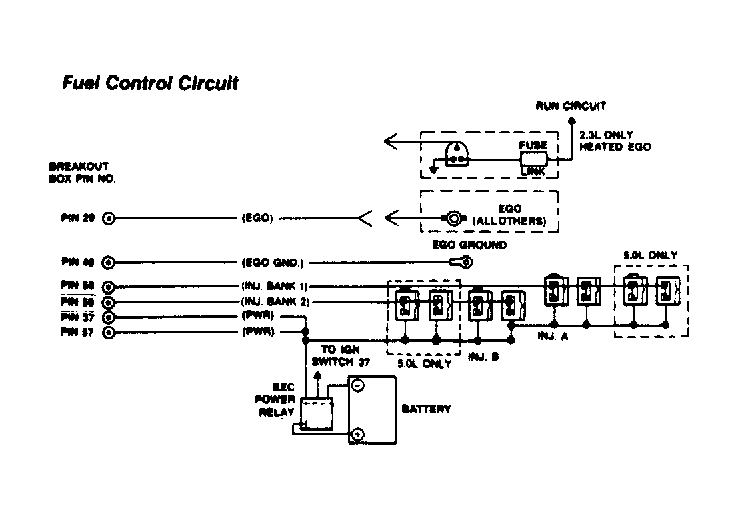
Test J - EFI Fuel Control
- Code 41. Connect tachometer and run engine at 2000 rpm. Disconnect ISC and use throttle body stop screw to set engine speed. Disconnect and reconnect injectors one at a time. Note rpm drop for each injector. Each injector should drop 150 rpm for 2.3L EFI models and a 50 rpm drop for 5.0L EFI models.
- If okay, problem is with area common to all cylinders (air leak, vacuum leak etc.). Repair injection system as necessary. If test is not okay, replace faulty injector and repeat QUICK TEST
. Reset curb idle. Check VECI decal for proper specifications.
- Code 42. Turn key off and wait 10 seconds. If code does not set, go to step 4). Check for fuel contamination in engine oil, ignition caused misfire or CANP problems. Disconnect vehicle harness at EGO sensor. Using a jumper wire, ground EGO harness at EGO sensor-to-engine block. Repeat KEY ON-ENGINE RUNNING (KOER) SELF-TEST
.
- Code 41 EGO Harness Check. Turn key off and wait 10 seconds. Install breakout box and measure resistance between test pin 49 and EGO ground at engine block. Measure resistance between test pin 29 and EGO harness connector. If both circuits are less than 5 ohms, disconnect processor connector. Inspect for damage or corrosion. If okay, replace processor and repeat QUICK TEST
. If not okay, repair harness circuit and repeat QUICK TEST
.
- Code 41. Place DVOM on 20 volt scale. With EGO sensor disconnected from harness, connect DVOM from EGO sensor to engine ground. Disconnect PCV hose and run engine at approximately 2000 rpm. If DVOM reads less than .4 volt within one minute, EGO sensor is okay. Go to step 1). If reading is more than .4 volt, replace EGO sensor and repeat QUICK TEST
.
- Code 41. Check for vacuum/air leaks first. If okay, turn key off and place DVOM on 20 volt scale. Disconnect EGO sensor from vehicle harness. Connect DVOM to EGO sensor and engine ground. Disconnect ACT sensor. Start engine and run at approximately 2000 rpm. If DVOM reading is greater than .5 volt in one minute, go to step 7). If reading is less than .5 volt in one minute, replace EGO sensor and repeat QUICK TEST
.
- Turn key off. Install breakout box and disconnect processor. Measure resistance between test pin 49 and engine block ground. Check resistance between EGO connector and test pin 29. If both circuits have less than 5 ohms resistance, go to step 8). If circuits have more than 5 ohms resistance, repair harness as necessary and repeat QUICK TEST
.
- Turn key off. Install breakout box and disconnect processor. Set DVOM to 200k ohms range. Measure resistance between test pin 29 and test pin 40. If reading is more than 10K ohms, go to step 9). If reading is less than 10K ohms, correct cause of resistance to ground. Repeat QUICK TEST
.
- To eliminate code 41, turn key off. Reconnect EGO sensor. Make certain that ACT sensor is still disconnected. Start engine and run at approximately 2000 rpm for one minute. Allow engine to return to idle. Perform KEY ON-ENGINE RUNNING (KOER) SELF-TEST
. If code is still present, inspect for corrosion or damaged connector pins. If okay, replace processor and repeat QUICK TEST
.
- Continuous Testing: Code 41/42. If code 41 is displayed, EGO indicated the fuel system was lean for more than 15 seconds when the system should have been in "Closed Loop" fuel control. When system is in "Closed Loop", the fuel control is under the influence of the EGO sensor. When system is in "Open Loop", fuel control is not under the influence of the EGO sensor.
- Check the following areas for a continuous code 41 or 42:
- Check for unmetered air (vacuum or intake leaks, canister purge system, PCV system etc.).
- EGO is fuel fouled.
- Check fuel pressure. Perform step 1) test.
- Check ignition system.
- Check TP sensor. Connect DVOM to test pin 47 and to pin 46. Turn ignition switch to "RUN" position. Observe DVOM while moving throttle. Reading must increase in throttle opening. If not correct, replace components as necessary.
- Turn key off. Set DVOM on 200 ohm scale. Measure resistance between run circuit and ground on heated EGO (HEGO) connector (at room temperature). If reading is between 2.5 and 5.0 ohms, go to step 13). If reading is less than 2.5 or greater than 5.0 ohms, replace HEGO sensor.
- Check for power at HEGO harness. Turn key on and set DVOM on 20 volt scale. Connect positive lead to run circuit and negative lead to ground on HEGO harness connector. If reading is 10.5 volts or greater, HEGO sensor system is okay. If reading is less than 10.5 volts, go to step 14).
- Check continuity of ground to HEGO connector. Turn key off, wait 10 seconds. Set DVOM on 200 ohm scale. Measure resistance of ground circuit from HEGO connector to battery ground. If reading is less than 5.0 ohms, repair open in run circuit. If reading is more than 5.0 ohms, repair open in ground circuit. If engine ran for more than 2 minutes before performing Engine Running Self-Test, go to next step. If engine did not run for more than 2 minutes, prepare vehicle and perform KEY ON-ENGINE RUNNING (KOER) SELF-TEST
.