Cold Engine
- Ensure engine coolant temperature is lower than 158°F (70°C). Start engine and allow it to idle. Turn A/C on. Check engine speed with compressor running.
- Engine speed should raise to speed specified in chart with A/C on. If engine speed is not within specifications, adjust with idle adjusting screw. Go to IDLE BOOST CONTROL A/C, HOT ENGINE section.
ENGINE IDLE SPEED
| Application |
Man. Trans. |
Auto. Trans. |
| California |
750-850 |
750-850 |
| Federal |
750-850 |
750-850 |
| High Altitude |
700-800 |
700-800 |
- If engine speed cannot be adjusted with adjusting screw, check for voltage at idle control solenoid valve wire (Light Blue), with A/C on. There should be voltage. If there is no voltage, go to steps 5) through 13). If there is voltage, disconnect vacuum hose from idle boost diaphragm and check for vacuum. There should be vacuum.
- If there is vacuum, replace idle boost diaphragm and retest. If there is no vacuum, disconnect the lower tube from idle boost solenoid valve and check for vacuum. If there is vacuum, replace idle boost solenoid valve and retest. If there is no vacuum, check for blockage or leaks. Clean and/or replace vacuum hose as necessary.
- If there is no voltage at idle control solenoid, check for voltage at control unit connector wire (Blue) with ignition on. There should be voltage. If there is no voltage, check wire (Blue) between ignition coil and control unit.
- Inspect 15 MPH speed sensor. Jack up and support front of vehicle, block rear wheels and set hand brake. Push test light/volt meter positive probe into the wire terminal (Yellow/Black) at the control unit connector. Connect negative probe to ground.
- Start engine. Select 2nd gear and accelerate slowly, while observing voltmeter. Voltmeter should show battery voltage below 11 MPH and no voltage above 16 MPH. If readings are as specified then speed sensor is okay. Stop engine, lower vehicle and remove voltmeter.
- If voltmeter readings do not correspond with MPH ranges, install new speed sensor and retest. If there is no voltage during speed sensor test, check for bad electrical connection, fuse or failed speed sensor. Repair or replace as necessary and retest as in step 7).
- Inspect thermosensor. In order to confirm proper operation, thermosensor must be checked once with cold engine and once with hot engine. Ensure that engine temperature for first test is less than 104°F (40°C).
- Disconnect the connector at control unit. Check for resistance between (Blue/Yellow) and (Brown/Black) terminals. Resistance should be 1000 ohms. Run engine until cooling fan comes on at least once and temperature is 194°F (90°C) for second test. Check resistance again. Resistance should be about 200 ohms.
- If resistance is outside the 200-1000 ohm range, replace thermosensor and retest. If ohmmeter shows no continuity, check wires. If there are no defects, replace thermosensor and retest.
- Inspect A/C control switch for continuity. There should be continuity between No. 12 and No. 13 terminals when switch button is pushed in (on), And no continuity when switch button is released (off). Replace switch as necessary. See Fig 1
.
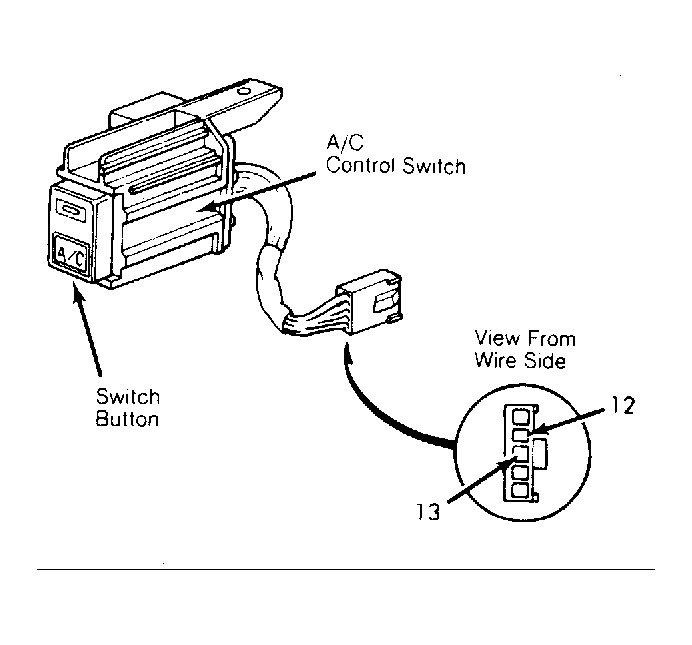 Courtesy of AMERICAN HONDA MOTOR CO., INC.
- Check for voltage at control unit connector wire (Black/Yellow) with ignition on. There should be voltage. If there is no voltage, check the wiring. Check wire (Brown/Black) between control unit and ground for continuity. Wire should have continuity.