Power Valve
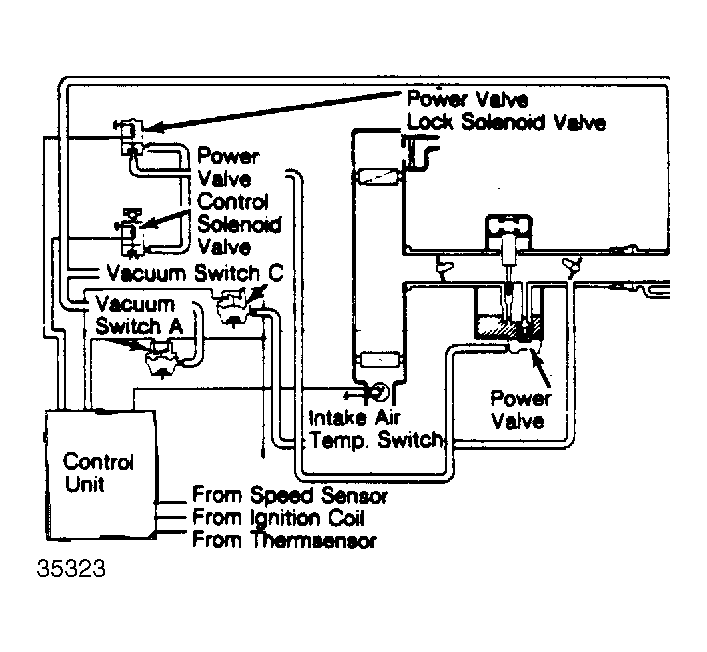
- With engine warm, disconnect hose from power valve and connect a vacuum pump to valve. Operate vacuum pump and ensure vacuum remains steady. If not, replace power valve diaphragm and retest.
- Connect vacuum gauge to hose for power valve. Start engine. Vacuum should be present at idle. If vacuum is present, go to step 16). If there is no vacuum, check for voltage at the lock solenoid. If there is no voltage, check and repair wiring, fuse or connections. If voltage is present, go on to next step.
- Check for vacuum between the power valve control solenoid valve and lock solenoid valve. If present, replace lock solenoid and retest. If there is no vacuum, check for voltage at power valve control solenoid wire (Pink).
- If voltage is present, replace power valve control solenoid and retest for voltage. If there is no voltage, continue to next step.
- If there is no voltage, check for voltage at control unit connector wire (Blue) with ignition on. There should be voltage. If there is no voltage, check wire (Blue) between ignition coil and control unit.
- Inspect 15 MPH speed sensor. Jack up and support front of vehicle, block rear wheels and set hand brake. Push test light/volt meter positive probe into the wire terminal (Yellow/Black) at the control unit connector. Connect negative probe to ground.
- Start engine. Select 2nd gear and accelerate slowly, while observing voltmeter. Voltmeter should show battery voltage below 11 MPH and no voltage above 16 MPH. If readings are as specified then speed sensor is okay. Stop engine, lower vehicle and remove voltmeter.
- If voltmeter readings do not correspond with MPH ranges, install new speed sensor and retest. If there is no voltage during speed sensor test, check for bad electrical connection, fuse or failed speed sensor. Repair or replace as necessary and retest as in steps 6) and 7).
- Inspect thermosensor. In order to confirm proper operation, thermosensor must be checked once with cold engine and once with hot engine. Ensure that engine temperature for first test is less than 104°F (40°C).
- Disconnect the connector at control unit. Check for resistance between (Blue/Yellow) and (Brown/Black) terminals. Resistance should be 1000 ohms. Run engine until cooling fan comes on at least once and temperature is 194°F (90°C) for second test. Check resistance again. Resistance should be about 200 ohms.
- If resistance is outside the 200-1000 ohm range, replace thermosensor and retest. If ohmmeter shows no continuity, check wires. If there are no defects, replace thermosensor and retest.
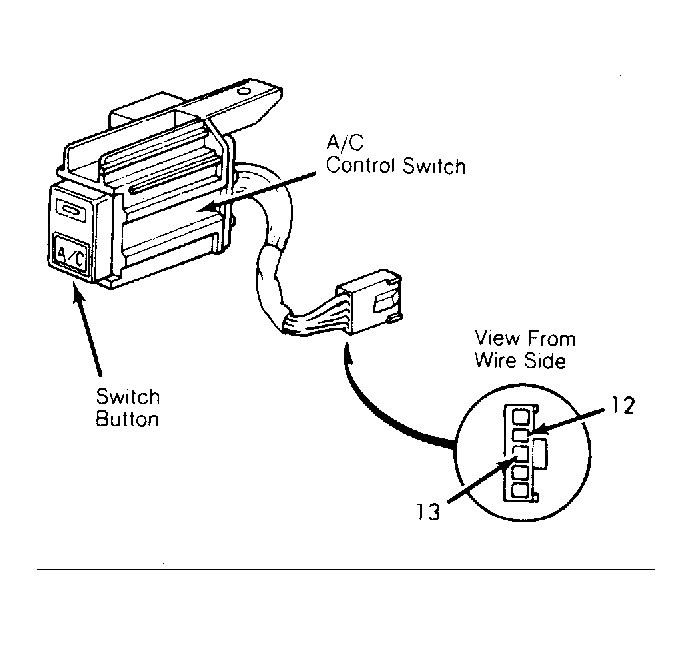
- Inspect intake air temperature switch. Disconnect intake air switch connector. Check continuity across its terminals. Sensor should have no continuity if air temperature is above 73°F (23°C), and have continuity if air temperature is below 40°F (4.5°C). Replace sensor if continuity is not as specified. See Fig 1
.
 Courtesy of AMERICAN HONDA MOTOR CO., INC.
- Inspect vacuum switch "A". Disconnect hose No. 2 to control box at vacuum hose manifold. Connect vacuum pump to hose. Applying 4 in. Hg, there should be no continuity with vacuum supplied, and continuity when vacuum is released.
- Inspect vacuum switch "C". Disconnect hose No. 15 to control box at vacuum hose manifold. Connect vacuum pump to hose applying 12 in. Hg. Check continuity between (Black/Yellow) and (Blue/Black) wire terminals (6P connector) at control box. There should be continuity when vacuum is applied and no continuity when vacuum is released.
- Check for voltage at control unit connector wire (Black/Yellow) with ignition on. There should be voltage. If no voltage, check the wiring. Check (Brown/Black) wire between control unit and ground for continuity. Wire should have continuity.
 Courtesy of AMERICAN HONDA MOTOR CO., INC.
- Turn ignition off. Ensure vacuum remains steady. If not, replace the lock solenoid valve and retest. Remove the No. 1 control box cover. Pinch off hose connected to vacuum switch "A". Disconnect the upper tube from lock solenoid valve and connect a vacuum pump. Operate engine above 3000 RPM. There should be no vacuum. If vacuum is present, check for voltage at power valve control solenoid valve.
- If voltage is present, use test procedures 4) thru 16). If no voltage is found, replace power valve control solenoid valve and retest.